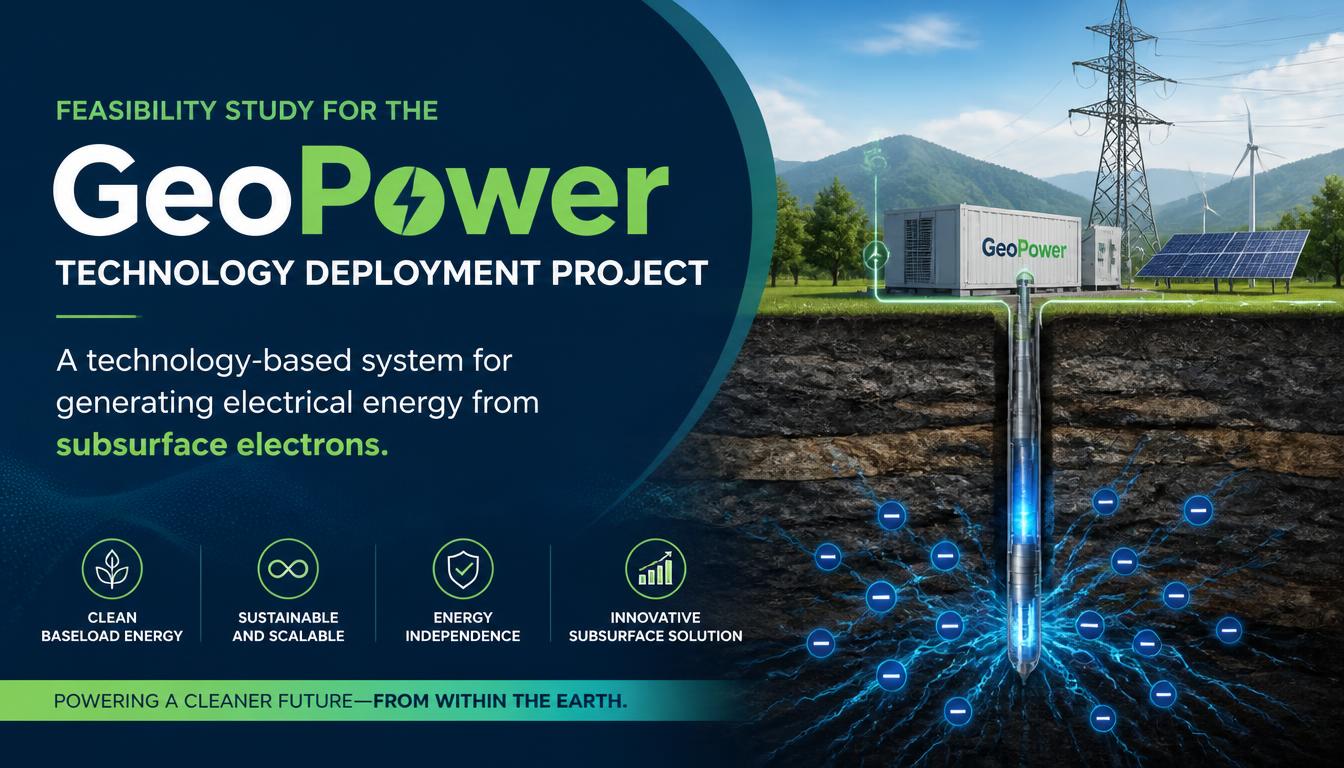
Feasibility Study for the GeoPower Technology Deployment Project
A Scalable and Technology-Based System for Electrical Energy Generation
Author and Inventor of the GeoPower Project: Hossein Sadegh ghol Moghadam
1: Objective of the Feasibility Study
The purpose of preparing this feasibility study is to establish an analytical, decision-oriented, and reliable framework for evaluating the possibility of entering an actual project based on GeoPower technology at an industrial or power-generation scale.
This document has been prepared with the approach of providing a “clear decision-making picture”, with a focus on establishing the technical, economic, and operational basis required for an investor or decision-making institution to make an informed decision regarding entering the next stages of cooperation.
In this feasibility study, it is assumed that the deployment of a 1-megawatt GeoPower unit constitutes an independent industrial or power-generation project rather than a limited pilot project. Accordingly, the objective of this feasibility study is to examine the rationale, requirements, and implications of entering an actual project of meaningful scale from technical, economic, operational, and strategic perspectives.
This feasibility study has been structured in a manner that:
- Enables a realistic evaluation of the technology under conditions close to industrial or power-generation operation;
- Clearly and systematically explains potential risks, uncertainties, and limitations;
- Presents possible decision-making and cooperation pathways to the investor without prematurely entering into definitive operational or financial commitments.
The expected outcome of this study is the ability to make an informed decision regarding whether or not to enter a GeoPower project at a specified scale and within a foreseeable time frame, under defined technical, economic, and operational conditions.
This decision may include initiating an actual deployment project or defining additional validation phases based on the analyses presented.
In summary, the objective of this feasibility study is to establish a professional platform for dialogue, analysis, and joint decision-making between the technology provider and the investor or decision-making institution; a platform that enables movement toward operational cooperation, provided that the results of the evaluations confirm the rationale for entering the project.
Section 2: The Problem Addressed by the GeoPower Project
(Problem Definition at the Macro Level)
The global energy system has faced a set of structural, simultaneous, and interconnected challenges in recent decades. These challenges are not merely technical or economic in nature; they also have geopolitical, social, and strategic dimensions and directly affect the stability of governments, energy security, economic development, and equitable access to vital resources.
One of the most fundamental of these challenges is the continuous increase in energy costs worldwide. Growing demand, limitations on fossil-fuel resources, fluctuations in global markets, extraction and transportation costs, and, in recent years, geopolitical pressures have caused energy prices to become a high-risk and unpredictable variable for governments, industries, and end consumers. This price instability has seriously disrupted long-term economic and industrial planning.
Alongside the issue of cost, the instability of electricity grids has become one of the major challenges facing energy systems. Centralized grids dependent on conventional power generation are vulnerable to sudden shocks, fuel shortages, natural disasters, or political crises. Widespread blackouts, reduced power quality, and inability to respond to peak demand not only reduce economic productivity but have also become a security and social risk for governments.
At the same time, carbon pressure and environmental requirements have imposed a new structural constraint on energy systems. International emissions-reduction commitments, strict environmental regulations, carbon taxes, and public pressure have effectively limited the room for maneuver of many traditional energy-generation solutions. However, many existing alternative technologies either have high costs or lead to complex infrastructures and new dependencies.
On the other hand, the global energy system’s heavy dependence on fossil fuels and centralized energy resources has created profound geopolitical consequences. A significant number of governments are structurally dependent on countries possessing fuel and energy resources; a dependency that is not only economic but also political and security-related. Within this framework, energy is used as a tool for applying pressure, imposing sanctions, or exercising political influence, and it significantly affects the balance of power among governments.
This dependency is also reflected in inequality in access to electrical energy. Despite technological progress, a significant portion of the world’s population still either lacks access to stable electricity or faces unaffordable energy costs. Concentrated generation, the need for extensive grids, and heavy infrastructure investment have caused equitable, local, and sustainable access to energy to remain an unresolved issue.
In response to these challenges, numerous solutions have been proposed and developed in recent years, ranging from conventional renewable energy sources such as solar and wind to grid optimization and increasing power-plant efficiency. However, these solutions also face structural limitations. Dependence on climatic conditions, the need for extensive energy storage, high infrastructure costs, the complexity of grid integration, and, in some cases, continued dependence on specific raw materials or supply chains have prevented these options, on their own, from providing a comprehensive and sustainable response to the energy problem at the macro level.
Within such a context, the fundamental issue is not merely “producing more energy,” but rather reducing dependency, increasing stability, enabling distributed generation, and redefining energy as a strategic asset independent of fuel and geopolitical conditions. The GeoPower project is defined precisely in response to this structural gap—not as a simple replacement for existing technologies, but as an effort to reconsider the logic of energy generation and reduce its entanglement with fuel, carbon, vulnerable grids, and geopolitical equations.
3: Proposed Approach and the Logic of the GeoPower Solution
The GeoPower approach is based on redefining the role of electricity-generation technology within the modern energy system; not as a limited alternative source, but as a stable, independent, and reinforcing layer alongside all existing electricity-generation and supply capacities. The system is designed to address the structural challenges of energy networks in a manner that enables it to play a meaningful role in increasing the stability, capacity, and flexibility of the electricity system at industrial and power-generation scales.
At the core of this approach, GeoPower is defined as a Base Load source; a source capable of providing stable, continuous, and reliable electricity generation without dependence on temporal fluctuations or environmental conditions. This characteristic distinguishes GeoPower from many modern energy-generation technologies and enables its use as a backbone for electricity supply in various industrial and power-generation scenarios.
At the same time, GeoPower is designed not in opposition to renewable energy, but as their strategic complement. The inherent limitations of resources such as solar and wind—including dependence on weather conditions, production fluctuations, and the need for energy storage—necessitate the presence of a stable and independent source alongside them. By providing stable output, GeoPower enables synergy with existing renewable capacities and contributes to grid balancing, reducing the need for costly storage and increasing the overall efficiency of the system.
One of the key characteristics of this system is its complete independence from climatic conditions and variable environmental resources. GeoPower does not depend on solar radiation, wind speed, water resources, or fossil fuels for electricity generation and, from this perspective, is capable of deployment across a wide range of geographical and climatic conditions. This characteristic significantly reduces operational risks and uncertainties associated with energy generation and enables stable long-term planning.
From a system-architecture perspective, GeoPower has been developed on the basis of a modular and scalable structure. This approach allows generation capacity to be increased in stages according to project requirements, site conditions, and development objectives. Modular scalability, in addition to reducing initial investment risk, enables the definition of diverse development scenarios, ranging from independent industrial deployments to large-scale power-generation projects.
Beyond this, GeoPower is designed to complement all existing electricity-generation capacities, including conventional power plants, renewable energy sources, and hybrid infrastructures. The system neither requires the immediate elimination or replacement of existing infrastructure nor depends on fundamental redesign of the grid. Instead, it can be gradually and purposefully added to the existing system and increase its efficiency.
One of the strategic consequences of this approach is an increase in the effective capacity of the electricity grid. The stable and reliable output of GeoPower makes it possible to reduce pressure on the grid, cover peak demand, and improve the reliability factor of electricity supply. As a result, the electricity grid is strengthened not only from the perspective of generation, but also in terms of stability and its ability to respond to demand; an issue of vital importance for large industries, critical facilities, and developing economies.
Overall, the logic of the GeoPower solution is based on creating a stable, independent, scalable, and synergistic source of electricity generation; a source that, without creating new dependencies, can play a key role in restructuring the modern energy system and reducing the gap between the technical requirements of the grid, environmental requirements, and the strategic considerations of governments and investors.
4: Technical Justification at the Decision-Making Level
GeoPower technology has been developed based on a system architecture in which the energy-generation system directly interacts with the Earth and its electrical structure. Within this architecture, the Earth is considered not merely as an electrical reference, but as an active part of the system; an aspect that inherently makes the system’s design, deployment, and operation project-specific and site-dependent.
At the system level, the operating logic of GeoPower is based on creating, directing, and managing electrical currents resulting from the interaction between the system and the Earth. This process is designed so that the system input remains within a stable control range, while the system output is a function of the site’s geoelectrical conditions, the grounding-system configuration, and the engineering configuration of the system’s key components. For this reason, the system output behavior is observed dynamically and varies over time; a behavior that does not indicate operational instability, but rather reflects the system’s direct dependence on the characteristics of its deployment site.
Practical experience obtained from constructed prototypes and conducted tests has shown that under conditions where the system input remains within a specified and controlled range, the output voltage and current values vary over different periods of time. These variations have been recorded and analyzed as system-performance data and have formed the basis for the project-oriented engineering design of the system. The approach adopted throughout this process has been to interpret these behaviors as inputs for system design and calibration, rather than attempting to artificially stabilize the output under unrealistic conditions.
Based on these detailed studies, GeoPower has entered the power-generation deployment engineering phase; a phase in which site studies are considered a fundamental prerequisite for design. Soil testing, grounding-system testing, assessment of ground resistivity, and analysis of the geoelectrical conditions of the installation site are defined as integral parts of the system-design process. The results of these studies are directly used in the design of the multilayer transformer, selection of the coupling configuration, and final calibration of the system at industrial or power-generation scale.
This approach demonstrates the technical maturity of the project because, instead of assuming a fixed output independent of the environment, the system has been designed to adapt itself to the actual conditions of the site. Within this framework, the output of the GeoPower system is considered a design parameter and the result of a controlled engineering process rather than a predetermined value. This characteristic enables scalability, modularization, and deployment of the system across diverse industrial and power-generation scenarios.
Accordingly, the technical justification for GeoPower in this proposal is based not on physical proof of performance, but on explaining the system logic, engineering architecture, existing practical experience, and the scientific and industrial validation pathway; a pathway that enables stakeholders to make an informed decision regarding entry into the definition phase of actual electrical energy-generation projects.
5: Operational Justification of the Project
From an operational perspective, the GeoPower project has been designed to be capable of actual deployment at industrial and power-generation sites. The system architecture, deployment logic, and design approach are based on project-oriented implementation in real-world environments, and all key components required for installation, commissioning, and operation at industrial scale have been considered in advance.
In terms of site installation capability, the GeoPower system is not dependent on special or inaccessible conditions and can be deployed across a wide range of sites, including industrial sites, power-generation sites, or areas independent of the grid. However, due to the nature of the system’s interaction with the Earth, project implementation requires initial site studies, including examination of soil, the grounding system, and the geoelectrical conditions of the deployment location. This dependency is not regarded as an operational obstacle, but rather as a standard part of the project-engineering process that enables more precise design, optimized performance, and reduced operational risks.
From an infrastructure perspective, project implementation requires the provision of conventional power-generation and industrial infrastructure, including suitable installation space, an engineered grounding system, energy transmission and conversion equipment, and access to control, protection, safety, and health infrastructure. These requirements fall within the established infrastructure framework of the electricity industry and do not require unconventional or inaccessible technologies or equipment. This makes it possible for the project to create synergy with existing infrastructure and reduce implementation costs and complexity.
Implementation of the GeoPower project is inherently a multi-institutional process and, depending on its scale and location, may require interaction with various institutions, including the site owner or operator, electricity-industry regulatory authorities, environmental organizations, and, in the event of grid connection, transmission or distribution network operators. The project framework is defined so that these interactions can take place through clear and manageable stages and to prevent premature entry into complex legal or administrative commitments.
From the perspective of operational sustainability, GeoPower is designed as a Base Load energy-generation system with minimal dependence on variable environmental conditions such as weather or temporal cycles. System stability is defined not on the basis of eliminating variations, but on the basis of understanding, modeling, and managing its dynamic behavior. This approach enables prediction of system behavior, appropriate protection design, and stable long-term operation.
At this stage, project risks and challenges are primarily operational, engineering, and site-adaptation risks rather than risks arising from an unknown technological operating principle. These risks have been identified and can be managed through tools such as site studies, project-oriented design, system modularization, and phased project implementation. The existence of this risk-management framework increases the ability to control costs, scheduling, and implementation quality throughout the project.
The GeoPower project has a clear and phased implementation pathway. This pathway begins with preliminary studies and project definition, then proceeds to project-oriented engineering design, operational validation, and finally deployment and operation at the desired scale. Such phasing makes it possible for decisions to be made gradually and based on actual data and prevents immediate entry into high-risk or high-cost projects.
Overall, the operational justification of GeoPower, according to the tests and research conducted, indicates that the project is not only technically reliable, but also has a clear operational rationale, an implementable pathway, identified risks, and an appropriate management structure for entering actual electrical energy-generation projects. These characteristics make GeoPower a serious and practical option for investors, implementing institutions, and decision-makers in the energy industry.
6: Macro-Level Economic Justification
The economic justification of the GeoPower project in this feasibility study has been developed with the objective of providing a macro-level decision-making framework for investors, implementing institutions, and strategic decision-makers in the energy industry. The focus of this section is not on predicting definite profitability or presenting final financial figures, but rather on explaining the economic rationale, the primary sources of value creation, and the cost position of this technology compared with conventional electricity-generation options.
Cost Structure (CAPEX / OPEX)
From the perspective of capital expenditures (CAPEX), the GeoPower system has a simpler and lower-cost structure compared with conventional thermal and fossil-fuel power plants and even many renewable power plants. Based on current estimates, the cost of establishing the reference capacity of 1 megawatt is estimated at approximately US$753,000. This figure includes the main components of the system, while costs such as installation infrastructure, energy conversion and transmission equipment, and basic power-generation requirements vary depending on the site location and can be approximately estimated. Given the system’s competitive price, GeoPower is positioned at a level that enables serious competition with all common electricity-generation options.
In terms of operating expenditures (OPEX), the economic advantage of GeoPower is considerably more pronounced. The absence of fuel consumption, elimination of the primary energy supply chain, reduced need for costly mechanical maintenance, and lack of dependence on continuous consumable resources, together with the system’s high efficiency and several-fold increase in power output, cause ongoing operating costs to remain structurally low and predictable. This characteristic makes the project more resilient to fluctuations in energy markets, fuel prices, and geopolitical shocks.
Primary Sources of Value Creation
The economic value of GeoPower is not limited merely to reducing system construction and support costs, but results from several complementary and synergistic sources. First, electricity generation at a significantly lower levelized cost than conventional power plants, which leads to increased profit margins or the possibility of supplying electricity at a lower price in the market. Second, the stability of generation as a Base Load source, which creates high grid value and can increase the practical capacity of the network. Third, the elimination of environmental pollution and its associated hidden costs, which, although not always directly reflected in financial models, play a decisive role in macroeconomic decision-making and energy policy.
In addition, GeoPower has the potential to create a structural transformation in the development model of modern power plants; such that, with further development and targeted research, it can also be utilized as an energy infrastructure in areas beyond electricity generation. This development potential creates significant Option Value for investors.
Economic Scenarios
Under the conservative scenario, GeoPower is considered a stable electricity-generation source with competitive capital costs and very low operating costs, serving only as a replacement for part of the capacity of conventional power plants. Even under this scenario, the project’s economic rationale is based on reducing generation costs, increasing grid stability, and shortening the investment payback period.
Under the optimistic scenario, taking into account site-specific design optimization and full utilization of the system’s characteristics, the effective efficiency of the system may be meaningfully higher compared with conventional power plants. This increase in efficiency, which depends on ground conditions and project design, leads to a further reduction in the levelized cost of electricity, faster return on investment, and increased economic attractiveness of the project at larger scales, without requiring unrealistic assumptions or unproven claims.
Conceptual Comparison with Other Options
Compared with fossil-fuel power plants, GeoPower has no fuel costs, environmental pollution, or risks arising from carbon regulations. Compared with conventional renewable power plants, the system is not dependent on variable environmental conditions such as solar radiation or wind and operates as a stable Base Load source. It also has more controlled operational complexity and capital costs compared with many emerging energy technologies.
Economic Summary
Overall, the economic justification of GeoPower is based on a clear and defensible rationale:
Competitive capital cost, very low operating cost, stable generation, elimination of fuel dependency, and the capacity to create grid value and economic development.
The purpose of this section is not to prove definite profitability, but to demonstrate that, from an economic perspective, GeoPower is positioned in a manner that allows it to be seriously considered as one of the lowest-cost, most stable, and most promising electricity-generation options at industrial and power-generation scales.
7: Risks and Risk-Management Approach
The GeoPower project, despite the technical and economic advantages presented, like any infrastructure project at industrial and power-generation scale, faces a set of identifiable risks. The approach of this feasibility study is neither to ignore the risks nor to exaggerate them, but to clarify their nature and present realistic pathways for managing them at the decision-making level.
From the perspective of technical risk, the primary challenge of the project lies not in the operating principle of the system, but in project-oriented design and engineering adaptation to the specific conditions of each site. GeoPower’s performance depends on ground characteristics, the grounding system, and environmental parameters, making site studies, soil testing, and dedicated design necessary before power-generation deployment. This dependency is not regarded as a technological weakness, but rather as a recognized engineering issue that can be managed through standard design, calibration, and multilayer engineering processes. The existence of practical experience and tested prototypes has moved the technical risk from the level of the “unknown” to the level of something that can be designed and controlled.
In the area of scalability risk, the primary issue concerns how system performance is transferred from limited scales to larger power-generation deployments. This risk is directly linked to the modular architecture of the system. GeoPower has been designed so that capacity expansion occurs not through a sudden increase in scale, but through the aggregation of modular units and phased project development. This approach allows scale-related risks to be managed gradually, separately, and in a correctable manner and prevents the project from entering high-risk points all at once.
Market acceptance risk is another key dimension of the project. As an emerging technology, GeoPower may encounter market skepticism, regulatory uncertainty, or resistance from traditional players in the energy industry during its early stages. This risk is more institutional and decision-oriented than technical in nature. The approach to managing this risk is to focus on specific, data-driven, and assessable projects, so that decision-makers are presented not with a general claim, but with an actual project, practical results, and a transparent economic framework. Phased market entry and professional dialogue with stakeholders are considered the primary tools for reducing this risk.
In addition to the above, the risk of increasing equipment and hardware prices is also identified as a real and unavoidable risk. Fluctuations in the prices of metals, electrical equipment, transformers, and industrial components can affect the project’s CAPEX structure. However, this risk is not specific to GeoPower and is faced by all power-generation projects. The approach to managing this risk includes flexible project design, the possibility of replacing suppliers, modularization of equipment, and defining price ranges during initial decision-making, so that the project is not locked into a specific route or supplier.
In summary, the risks of the GeoPower project are primarily in the areas of design, scale, and market acceptance rather than at the level of fundamental technological uncertainty. Transparent identification of these risks and the definition of approaches for managing them transform the project from a claim-based proposal into an option that can be evaluated and decided upon by investors, implementing institutions, and energy policymakers.
8: Decision-Making Pathways and Options for Entering Cooperation
This section of the feasibility study has been prepared to explain the practical pathways available to stakeholders and investors. GeoPower technology is currently at the stage of decision-making regarding the manner of entering cooperation, the level of commitment, and the scale of implementation, in a phased manner. The following scenarios are defined as different cooperation options rather than conflicting or competing pathways.
Scenario A: Controlled Entry into the Industrial or Power-Generation Phase
Under this scenario, cooperation begins with the definition and implementation of an actual project at an industrial or power-generation scale. The primary focus is on project-oriented design, selection of a suitable site, conducting ground and grounding studies, dedicated engineering design, and defining the system architecture according to the target capacity.
Under this pathway, the project is defined in phases so that, while maintaining risk control, the possibility of deciding on the development of higher capacities remains available.
Requirements of this Scenario:
- Participation of an investor or industrial partner
- Site selection and technical studies
- Definition of the operational and legal framework of cooperation
Outcomes:
- Practical entry of the technology into the energy-generation chain
- Establishment of a real basis for power-generation development
- Formation of an expandable technological and economic asset
Scenario B: Entry into Development Cooperation and Project Preparation
This scenario is suitable for parties that wish to focus on technical and economic preparation and project design before entering full implementation. Under this pathway, activities will focus on design optimization, analysis of economic scenarios, preparation of technical documentation, and establishment of a decision-making infrastructure for entering the implementation phase.
Requirements of this Scenario:
- Technical and analytical cooperation
- Access to site data and grid requirements
- Participation in the design and decision-making process
Outcomes:
- Reduction of the risk of entering the implementation phase
- Clarification of the project’s economic and engineering rationale
- Preparation for targeted investment in the next stage
Scenario C: Strategic Partnership and Long-Term Positioning
Under this scenario, the focus is on establishing a long-term strategic cooperation that may include technology transfer, joint development, or planning for multi-site and multi-capacity deployments in the future. This pathway is suitable for government institutions, major energy companies, or strategic investors.
Requirements of this Scenario:
- Strategic alignment
- Medium- and long-term perspective
- Definition of a multi-stage cooperation framework
Outcomes:
- Positioning within a transformative technology
- Early access to development capacities
- Participation in shaping the next generation of power plants
Summary
The decision-making pathways presented in this feasibility study are all based on focusing on and achieving the planned objective and are defined according to the manner of entering cooperation. The selection of each pathway depends on the objectives, time horizon, and level of participation of the other party, and this flexibility enables professional dialogue and informed decision-making.
9: Proposed Cooperation Framework and Partnership Models
Considering the infrastructural, scalable, and transformative nature of GeoPower technology, as well as the diversity of potential stakeholders—including professional investors, industrial partners, governmental institutions, and energy-market participants—the cooperation framework in this feasibility study is defined as multi-path, flexible, and adaptable.
The purpose of presenting this framework is to outline a conventional and recognized range of cooperation models at the international level that enables professional dialogue, comparative evaluation, and informed decision-making for different parties. Mentioning these models is solely intended to clarify potential cooperation options and does not in any way constitute a commitment, definite preference, or obligation to select a specific pathway.
Direct Investment Partnership (Equity Partnership)
Under this model, an investor or industrial partner may enter the capital structure of the project or the related implementing entity. This approach can provide a platform for aligning long-term interests, participating in the value creation of the technology, and participating in high-level decision-making processes. The ownership structure, level of participation, and return on investment will be subject to further review and agreement at subsequent stages.
Project-Based Partnership
This model focuses on defining and implementing a specific industrial or power-generation project based on GeoPower technology. Within this framework, cooperation is established without requiring entry into technology ownership or a long-term capital structure, with the focus placed on project-oriented design, deployment, and operation. This approach is considered suitable for parties seeking to practically implement the technology in a specific application or at a specific site.
Electricity Sales or Power Purchase Agreement (PPA)
Under this model, cooperation is structured around the generation and supply of electrical energy, and the other party may act as an electricity buyer and benefit from stable, predictable, and competitive energy generation without becoming involved in the technical or ownership complexities of the system. The contractual structures, tariffs, and duration of cooperation under this model can be defined at later stages.
BOT / BOO Models — at the Conceptual Level
Build–Operate–Transfer (BOT) and Build–Own–Operate (BOO) models are referenced conceptually in this feasibility study as recognized models for the development of infrastructure projects. These models may be considered particularly for large-scale projects or interactions with public and governmental institutions, depending on the legal and policy frameworks of each country.
Technology Licensing and Joint Development
Within this framework, the possibility of granting licenses for the use of GeoPower technology or jointly developing it in specific geographical, industrial, or application areas is proposed. This model can provide an appropriate cooperation pathway for companies or institutions seeking to localize, expand capacity, or broaden the applications of the technology without fully transferring ownership or control of the technology.
Public–Private Partnership (PPP)
Considering the potential role of GeoPower in increasing electricity-grid capacity, reducing dependence on fossil fuels, and enhancing energy security, cooperation through public–private partnerships is also presented as one of the pathways that may be considered. This model may be particularly relevant for national, regional, or development projects that require synergy between the public and private sectors.
Summary
The cooperation framework presented in this feasibility study reflects an analytical, commitment-oriented approach aligned with international practices for energy-project development. Rather than restricting the cooperation pathway, this framework places a clear range of possible options before decision-makers and provides the basis for professional dialogue, comparative evaluation, and selection of a cooperation model appropriate to the objectives, scale, and requirements of each project.
10: Feasibility Summary and Consolidation of the Decision-Making Framework
This feasibility study has been prepared with the objective of establishing a clear, reliable, and decision-oriented basis for evaluating GeoPower technology at the levels of investment, industrial partnership, and energy policy. The content of this document has been structured to enable simultaneous evaluation of the project’s technical rationale, operational capability, and economic logic within an integrated framework, without entering into definitive operational, contractual, or financial commitments.
Based on the analyses presented, GeoPower is neither a laboratory concept nor merely a theoretical proposal; rather, it is a technology that has moved beyond the proof-of-concept stage and possesses an established operating rationale, a definable implementation pathway, and the capacity for economic analysis at industrial and power-generation scales. The risks existing within the project have been transparently identified and are primarily related to project-oriented design, site conditions, and the engineering deployment of the system; issues that inherently exist in energy infrastructure projects and can be managed and phased.
This document does not specifically replace detailed engineering design, operational contracts, or binding financial documents. Its function is to provide a professional basis for informed decision-making regarding entry into the next stages of interaction; stages that may include defining specific projects, conducting supplementary technical and economic studies, or initiating structured discussions for cooperation at industrial, investment, or governmental levels.
Ultimately, the primary outcome of this feasibility study is to enable a realistic comparison of GeoPower with conventional electricity-generation options, define logical cooperation pathways appropriate to the objectives of the involved parties, and support analysis-based decision-making rather than decisions based on assumptions or initial perceptions. This document is intended to serve as a point of connection between understanding the technology and entering deeper operational and economic interactions, while providing the necessary framework for continuing professional dialogue.