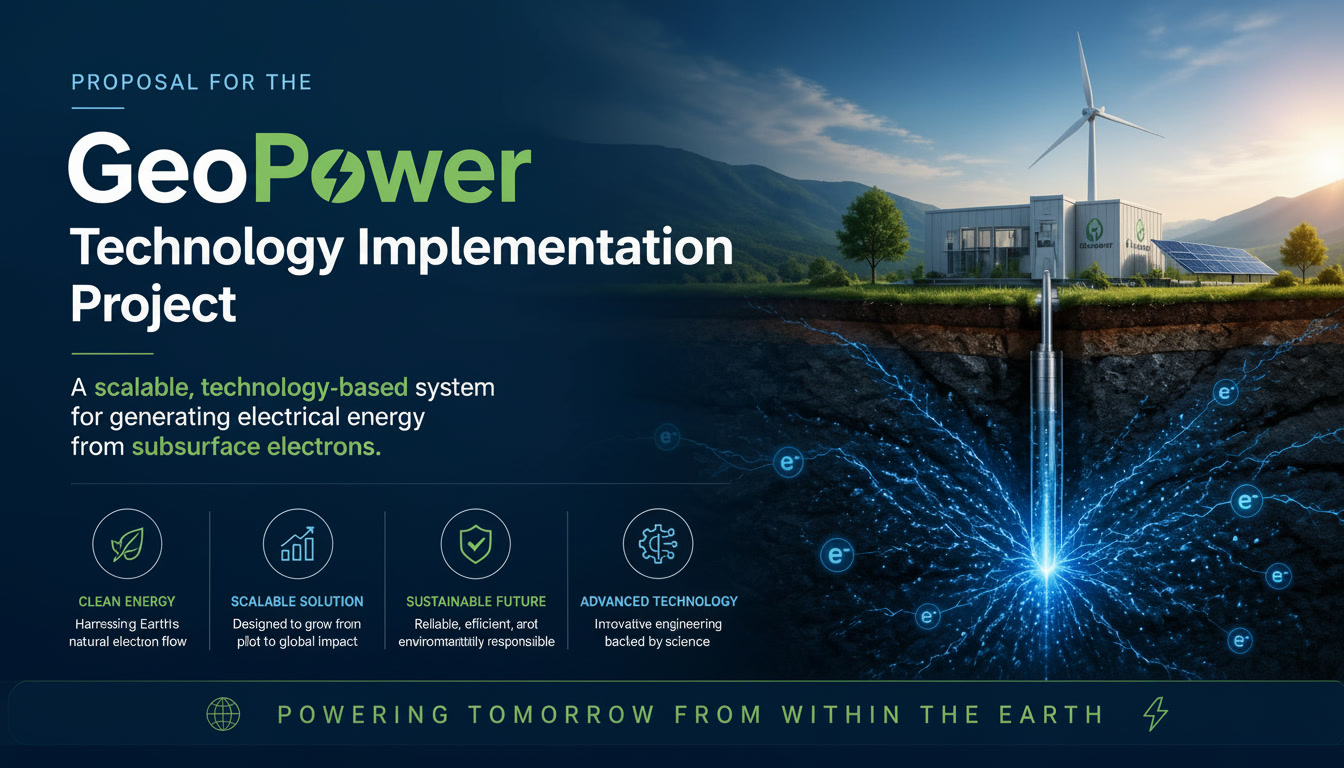
GeoPower Technology Deployment Project Proposal
A Scalable and Technological System for Electrical Energy Generation
Author and Inventor of the GeoPower Concept: Hossein Sadegh ghol Moghadam
- Executive Summary
GeoPower technology has been developed as an innovative infrastructure solution in the field of electrical energy generation, with the objective of addressing the structural, economic, and operational limitations of conventional power generation models. The technology is based on an engineered and scalable architecture designed to enable stable power generation without dependence on fuel supply chains, climatic conditions, or conventional energy resources.
At a time when the energy industry is facing challenges such as rising investment costs, infrastructural complexity, environmental constraints, and declining grid flexibility, GeoPower introduces an alternative approach: the generation of electrical energy from the subsurface layers of the Earth as an independent infrastructure that can be deployed at different scales and located close to the point of consumption. This approach is not intended as a consumer product, but rather as an engineering platform for redefining how power-generation systems are deployed and operated.
GeoPower technology has progressed beyond the conceptual and theoretical stages and has a physical prototype as well as practical operational experience. The development path completed to date indicates that the challenges ahead are not related to the “proof of principle,” but rather to project design, adaptation to site-specific conditions, and engineering scale-up at the industrial level. In other words, the system has entered a phase in which project-based deployment decision-making is the primary focus.
This proposal has been prepared to establish a clear framework for entering into a professional collaboration; a collaboration that may take the form of industrial or power-generation pilot projects, investment partnerships, joint development, or deployment of the system at defined scales. The scope of this proposal has been structured to enable technical and economic evaluation, risk management, and phased decision-making by the counterpart, without requiring disclosure of confidential technical knowledge or premature entry into unnecessary commitments.
GeoPower defines this collaboration not as a technology sale, but as a partnership in shaping a new infrastructure for electrical energy generation; an infrastructure with the potential to be developed at industrial scale and in global markets, and to play an effective role in the future of the energy industry. This proposal serves as the starting point for a professional dialogue to examine this shared path and define the next implementation steps.
- Project Introduction and Purpose of the Proposal
This proposal has been prepared to introduce the GeoPower technology deployment project and establish a clear framework for the initial evaluation and decision-making process regarding potential collaborations. The document focuses on explaining the nature of the project, the scope of the proposed collaboration, and the mutual expectations of the parties, in a manner that enables professional and phased evaluation by decision-making institutions, industrial partners, and investors.
The project addressed in this proposal focuses on the practical application of GeoPower technology at an industrial or power-generation scale and on the controlled transition from existing practical experience toward project-based deployment at larger scales. This project is neither solely a research activity nor a final commercial product offering. Rather, it lies between these two stages, at a point where engineering, economic, and implementation decisions play a determining role.
The primary objective of this proposal is to address the following key questions:
- Is the proposed project technically and infrastructurally feasible?
- How should the scope of cooperation and the role of each party be defined?
- What is the reference project scale and the initial decision-making framework?
- What is the logical path for entering the subsequent phases of cooperation?
This proposal intentionally does not enter into confidential design details, proprietary calculations, or exclusive technical know-how. Instead, it seeks to provide an accurate, defensible, and practical picture of the project’s rationale, technological maturity, and implementation requirements, enabling the counterpart to make a decision regarding the continuation of the cooperation process based on sufficient information.
In terms of scope, this document seeks to:
- Define a reference project based on a specific scale as the basis for analysis and negotiation;
- Clarify the responsibilities and mutual expectations of the parties;
- Establish the basis for conducting further evaluations in subsequent stages.
Ultimately, this proposal has been designed as an initial decision-making document. Its role is to establish mutual understanding between the parties and provide a foundation for entering professional negotiations and defining cooperation frameworks at industrial and power-generation levels, rather than serving as a substitute for a contract, feasibility study, or detailed engineering documentation.
- Introduction to GeoPower Technology at the System Level
GeoPower is an innovative infrastructure system for generating electrical energy using subsurface electrons of the Earth. It has been designed with a system-oriented approach and has the capability to be deployed at industrial and power-generation scales. The operating logic of the system is based on the interaction of electrical systems with Earth-based environments and the non-ideal behavior of materials. This technology is defined not as a consumer device, but as an infrastructure-based power-generation solution that can be implemented within centralized or decentralized architectures, depending on project requirements.
GeoPower operates on the basis of an engineered interaction between the designed electrical system and the physical and electrical characteristics of the Earth. In this system, the Earth is not merely considered a physical installation medium, but rather as an active part of the system’s operating environment. Therefore, the design and operation of GeoPower are inherently project-based and adapted to the conditions of each site.
From an architectural perspective, GeoPower is a multilayer and modular system whose components operate in coordination to receive, regulate, stabilize, and deliver electrical energy. This architecture enables genuine system scalability, such that an increase in generation capacity is achieved not by simply enlarging a single unit, but through the structural and engineered expansion of the system.
Unlike conventional power plants, which have a direct dependence on fuel supply chains, climatic conditions, or unstable energy resources, GeoPower has been designed as an infrastructure technology with the objective of reducing these dependencies and simplifying the complex layers involved in electricity generation. This approach provides greater flexibility in site selection, project design, and long-term operation.
At the functional level, GeoPower requires a controlled electrical power input for stable electrical energy generation. However, its operating logic is designed in such a way that the system output is not simply a direct function of the input, but rather the result of a systematic process involving interaction with the Earth environment and the internal architecture of the system. A detailed explanation of this logic is not provided in this proposal and will be examined in supplementary documents and within the framework of professional interactions.
Overall, GeoPower is a developed technology with an infrastructure-oriented approach, whose objective is to establish a new pathway for electrical energy generation; a pathway that, from engineering, economic, and implementation perspectives, has the potential to be adapted to real and decision-driven projects and evaluated as a basis for industrial and power-generation cooperation.
- The Problem Addressed by the GeoPower Project
The electrical power generation industry has faced a range of structural, economic, and strategic challenges over recent decades. Many of these challenges are not caused by a lack of technology, but rather by inherent limitations in conventional approaches to electricity generation. Increasing global energy demand, pressure on existing infrastructure, and increasingly stringent environmental requirements have made the need to reconsider conventional models of electricity generation and distribution more evident.
One of the fundamental challenges in today’s electricity generation is high dependence on complex energy supply chains; chains that include the extraction, transportation, storage, and consumption of fuel resources, or dependence on climatic conditions and unstable resources. These dependencies not only create operational and economic risks, but also reduce the flexibility of electricity-generation systems when facing crises and environmental fluctuations.
In addition, the high concentration of power generation in geographically limited locations and the considerable distance between generation and consumption points have resulted in increased structural grid losses, greater transmission infrastructure complexity, and higher investment and maintenance costs. This issue has a direct impact on the overall efficiency and economic sustainability of large industrial and power-generation projects.
From an economic perspective, many conventional power plants face heavy investment cycles, long payback periods, and unpredictable operating costs. Fluctuations in fuel prices, direct and indirect environmental costs, and the need for extensive supporting infrastructure make investment decisions in this sector more complex and risk-sensitive.
At a broader strategic level, the fundamental issue is that a significant portion of existing technologies, rather than simplifying the electricity-generation system, have added new layers of complexity to it. As a result, despite technological progress, there remains a need for approaches capable of redefining electricity generation as stable, scalable, and adaptable infrastructure.
The GeoPower project has emerged in response to this set of challenges. The project seeks to propose a different pathway for electrical energy generation through a new infrastructure technology; a pathway that reduces dependence on conventional energy supply chains, enables deployment closer to the point of consumption, and establishes a flexible framework for designing industrial and power-generation projects.
GeoPower does not seek to directly replace all existing solutions. Instead, by focusing on addressing current structural limitations, it provides a platform for new decision-making approaches in the development of electricity-generation infrastructure; a platform that can be evaluated and implemented in real projects according to requirements, scale, and site conditions.
- Current Development Status and Project Readiness
GeoPower technology is the result of an eleven-year path of gradual development based on practical experience. It has progressed beyond the conceptual stage and reached a level of engineering maturity that enables evaluation and decision-making for deployment in real projects. The technology is the result of an independent and focused development process that has continuously progressed through direct interaction with a physical prototype. At its current stage, the project’s focus is on engineering implementation, adaptation to site conditions, and defining implementation frameworks at industrial and power-generation scales.
The GeoPower system has a built and tested physical prototype, and its performance has been observed and analyzed under real conditions. These tests were conducted to understand system behavior, identify environmental variables affecting performance, and evaluate the system’s response in interaction with the Earth. The results of this development path indicate that system performance is directly dependent on project-based design and site-specific ground conditions; a factor regarded as a known and manageable engineering characteristic rather than a technological uncertainty.
In specialized tests conducted under the most demanding conditions of current international standards, the system achieved significant results with acceptable performance, demonstrating performance above and better than conventional electricity-generation methods. In tests conducted by an independent and reputable laboratory, the system began operation with an input of 637.2 watts, while recorded output figures ranged from 2,100 watts to 6,300 watts. An official, valid, and verifiable test certificate was also issued for the tests conducted.
At this stage, the challenges facing the project are primarily related to customized design, site engineering, scaling, and infrastructure integration, rather than uncertainty regarding the system’s operating principle. This distinction places GeoPower in a position where it can enter the phase of defining specific projects, conducting targeted technical and economic analyses, and engaging in decision-oriented discussions with industrial partners, investors, or implementation institutions.
The system architecture has been developed to enable gradual capacity expansion, modularization, and implementation across different industrial and power-generation scenarios. This characteristic makes implementation risks separable and manageable, allowing projects to be defined through specific and controllable phases rather than entering very large scales all at once.
In summary, GeoPower is at a stage of development in which:
- Its operating principle has been established;
- A physical prototype and practical experience exist;
- Risks are primarily limited to site-specific conditions;
- The system has been tested and evaluated by an independent laboratory;
- The system is ready to enter the decision-making phase for industrial and power-generation deployment.
This status distinguishes GeoPower from a conceptual or purely research-oriented project and makes it an option that can be considered for real electrical energy-generation projects.
- Proposed Project Scope
The proposed project scope in this proposal has been defined with the objective of establishing a clear, evaluable, and decision-oriented framework for initiating cooperation in the deployment of GeoPower technology. The project is designed so that its outcome provides both parties with the ability to make informed, data-based decisions regarding capacity development at a defined megawatt scale and within a defined time period. The scope has been structured to allow practical and realistic evaluation of the technology at an industrial or power-generation scale while avoiding premature entry into definitive operational or commercial commitments and preserving the necessary flexibility to adapt the project to the objectives, requirements, and priorities of the counterpart.
The nature of the proposed project is the definition and design of a real deployment based on GeoPower technology. It may be structured as an industrial or power-generation pilot project or as the initial phase of a larger project. Within this framework, the primary focus is on project-based engineering design, adaptation of the system to site conditions, and evaluation of the operational and infrastructure requirements associated with technology deployment, rather than merely demonstrating performance or conducting a limited experimental implementation.
To establish a common basis for technical, economic, and implementation analysis, the reference project scale is based on a 1-megawatt unit.
This scale serves as an analytical and design unit and does not in any way represent a limitation on the final capacity of the project or an obligation to deploy at this specific power level. The modular architecture of the system allows capacity to be expanded to higher scales, including several thousand megawatts, or allows combined scenarios to be defined in subsequent stages.
Within the scope of this proposal, items including project framework definition, determination of the type of application (industrial or power-generation), identification of site requirements, project-based conceptual design, determination of infrastructure requirements, and clarification of the roles and responsibilities of the parties at a general level are included. The scope also allows for an initial examination of the project’s economic rationale, capacity-development scenarios, and potential cooperation pathways without entering into binding financial or contractual details.
In contrast, items such as detailed engineering design, disclosure of confidential technical details, proprietary calculations, final pricing, definitive implementation commitments, detailed execution schedules, and complete construction or deployment of the system at its final scale are outside the scope of this proposal. These matters will only be examined at later stages following initial agreement on the cooperation framework.
Overall, the proposed project scope is defined as a “decision-making bridge”; a bridge between understanding the technology and entering into implementation cooperation, providing the parties with the ability to conduct detailed evaluation, engage in professional dialogue, and make informed decisions without prematurely limiting or committing the future path of cooperation.
- Proposed Cooperation Models
Given the infrastructure-oriented nature of GeoPower technology and the diversity of its deployment scenarios at industrial and power-generation scales, this proposal adopts a flexible approach toward cooperation models. The objective of this approach is to establish a basis for dialogue and decision-making that is aligned with the priorities, capabilities, and strategies of the counterpart rather than imposing a predetermined model.
Within this framework, cooperation may be defined in various forms, each of which can be adjusted according to the type of project, expected level of participation, and time horizon of the cooperation. These forms may include joint project implementation, investment partnership, industrial cooperation in system deployment and development, or a combination of these approaches. The final cooperation model will be determined through technical and economic discussions and alignment of the parties’ objectives.
Under a joint project implementation scenario, the focus would be on defining and implementing a specific project, such as an industrial or power-generation pilot, in which the roles, responsibilities, and contribution of each party are clearly defined. This model provides an opportunity to evaluate the technology in a real-world environment and support decision-making for subsequent development.
Under an investment partnership model, the primary focus would be on providing the financial resources required for project deployment and system capacity development. This model may be considered by professional investors or funds seeking to enter the energy infrastructure sector with a long-term perspective.
Under industrial cooperation scenarios, participation may be defined in areas such as manufacturing, infrastructure integration, operation, or supply-chain development. This type of cooperation may be particularly relevant to industrial or power-generation companies seeking to add an innovative technology to their asset portfolio or capabilities.
A key point across all of these models is that this proposal deliberately avoids premature entry into definitive contractual, financial, or operational commitments. The objective at this stage is to establish a flexible and negotiable framework that allows the cooperation model to be adapted to the realities of the project, site requirements, and mutual interests of the parties.
Ultimately, the selected cooperation model can be developed progressively and in phases, so that after defining the initial project and evaluating its results, the path toward larger-scale cooperation or longer-term horizons can be established with greater certainty and confidence.
- Key Project Implementation Requirements
Successful implementation of the GeoPower system at an industrial and power-generation scale requires compliance with a set of engineering and implementation requirements whose nature is primarily related to project design, adaptation to site conditions, and infrastructure integration, rather than technology development or proof of the technology. These requirements establish a clear framework for defining responsibilities, managing risks, and ensuring stable system performance in real projects.
8.1. Evaluation of Ground Characteristics and Site Conditions
One of the fundamental requirements for project implementation is a detailed understanding of the characteristics of the ground at the system deployment site. The electrical behavior of the Earth, the layered structure of soil and rock, moisture levels, the presence of subsurface water, and the composition of mineral materials all directly influence how the system interacts with its surrounding environment.
These evaluations are conducted with the objective of ensuring sufficient site area for operation and modeling the response of the ground at the project scale. They are used as engineering inputs for system design rather than being treated as limiting factors or unknown risks.
8.2. Design and Configuration of the Grounding Connection System
The connection of the system to the ground in GeoPower is considered an engineered system, rather than merely a standard electrical requirement. The arrangement of grounding wells, the distribution of connections, and their interaction with the designed layers of the system must be defined according to site conditions and project scale.
This approach enables better control of currents, operational stability, and safe management of electrical potentials within the project area.
8.3. Customized, Project-Based Design
GeoPower has inherently been developed on the basis of customized design for each project. This customized design does not mean changing the operating principle of the system; rather, it means adapting the architecture, module arrangement, and operating parameters to the actual site conditions, required capacity, and operating scenario.
This approach allows the system to move beyond the form of a generic solution and become an engineered, predictable, and controllable solution at the project level.
8.4. Infrastructure Requirements and Integration with the Operating Environment
Project implementation requires the availability of basic infrastructure, including technical access, installation facilities, connection to networks or target consumers, and safety and control requirements.
These requirements will vary depending on the type of project (industrial or power-generation), deployment location, and operating scenario, and will be clearly defined between the parties within the project-definition framework. The purpose of this integration is to ensure stable system performance and reduce implementation complexities during operation.
Section Summary
The implementation requirements for the GeoPower project have been defined so that:
- Uncertainties are managed through engineering methods;
- Design and implementation are based on actual site data;
- Projects progress within controllable, evaluable, and decision-oriented frameworks.
These requirements demonstrate that GeoPower’s entry into real projects requires precise engineering and implementation decision-making.
- Economic Value and Investment Rationale (At the High Level)
As an infrastructure system for electrical energy generation, GeoPower does not define its economic value solely in terms of energy sales or reduced operating costs. Rather, it presents its value at a higher and more structural level as the creation of a stable productive asset with long-term economic, environmental, and developmental implications.
The investment rationale for GeoPower is based on the simultaneous combination of direct financial benefits and broader values that cannot necessarily be quantified numerically; values that play a determining role in the strategic decisions of governments, infrastructure investors, and major industries.
9.1. Economic Stability Resulting from Independence from Fuel Supply Chains
One of the fundamental economic components of GeoPower is its structural independence from fossil fuels, complex supply chains, logistics, storage, and energy-market fluctuations.
This characteristic makes the system’s operating costs largely independent of external and uncontrollable factors and moves the project toward a stable and predictable long-term cost environment; an aspect that represents a determining advantage for large-scale infrastructure investments.
9.2. Elimination of Environmental Pollution as a Hidden but Real Economic Value
The absence of combustion processes, chemical pollutants, and environmental impacts, although it may not be directly priced in short-term financial calculations, represents a highly significant and strategic economic value at the macro level.
Reduced social, healthcare, environmental, and regulatory costs associated with energy generation, particularly over the long term, make GeoPower an option aligned with sustainable-development policies and the energy transition; an advantage that can play a key role in the decisions of governmental institutions and responsible investors.
9.3. Reduction of Structural Losses and Increased Effective Grid Efficiency
The ability to deploy the system close to the point of consumption or at optimized locations within the grid can reduce energy transmission and distribution losses. This directly increases the effective efficiency of the generation–consumption system and increases the real value of the energy generated.
At the macro level, this means increasing the effective capacity of the grid without necessarily requiring costly expansion of transmission infrastructure.
9.4. Modular Architecture and Phased Investment Management
The modular architecture of GeoPower enables projects to be defined in independent and expandable phases. This approach allows investors and project operators to make investments gradually and in a controlled manner rather than entering very large scales all at once.
As a result, investment risk is naturally distributed, and decisions can be adjusted and optimized based on the actual performance data of each phase.
9.5. Transformation of the Modern Power-Plant Construction Model
GeoPower is not merely an alternative solution for electricity generation, but rather represents a paradigm shift in the architecture of modern power plants. Simplifying power-plant structures, eliminating fuel dependence, and reducing infrastructure complexity open a new pathway for the design and deployment of power plants.
With further development and research, this transformation has the potential to expand into broader areas of energy supply in the future and create new economic opportunities.
9.6. Increasing the Economic Capacity of the Grid and Enabling Regional Development
The ability to expand generation capacity across different geographical locations and the lack of dependence on centralized fuel resources make GeoPower an effective tool for increasing grid resilience and enabling economic growth in less-developed regions.
Stable access to electrical energy is a fundamental infrastructure requirement for industrial development, employment generation, and economic growth. GeoPower makes it possible to provide this infrastructure to communities and countries with fewer costs and limitations.
9.7. High Operational Lifetime and Sustainability of the Capital Asset
The system has been designed to have limited operational degradation and to enable modular maintenance and upgrading. This helps preserve a substantial portion of the investment value over time and allows the system to remain a reliable long-term infrastructure asset.
9.8. An Analyzable and Decision-Oriented Investment Payback Path
Although a detailed numerical analysis of financial indicators has not been targeted at this stage and is delegated to an independent feasibility study, the technical and implementation structure of GeoPower enables clear investment-return scenarios to be defined.
This characteristic provides a foundation for informed and phased decision-making by professional investors and implementing institutions.
Section Summary
Overall, GeoPower is neither solely an economic technology nor solely an environmental technology. Rather, it offers a combination of financial value, long-term sustainability, infrastructure transformation, and economic development enablement.
These combined values make GeoPower an option worthy of consideration for strategic investments in the energy sector; an option that considers not only project profitability but also the future of energy infrastructure and sustainable development.
- Risks, Considerations, and Risk-Management Approach
Every infrastructure project in the energy sector, particularly at industrial and power-generation scales, inherently involves a range of technical, implementation, and decision-making risks and considerations. GeoPower’s approach to this issue is neither to ignore risks nor to exaggerate them, but rather to identify them transparently, distinguish them appropriately, and manage them through engineering at the project level.
Within this framework, risks are regarded as analyzable and controllable components rather than fundamental barriers to the technology.
10.1. Technical Risks (At the Project Level, Not at the Technology-Principle Level)
The technical risks associated with GeoPower are primarily related to project-based design, adaptation to site conditions, and engineering scale-up.
The operating logic of the system and its physical and electrical principles have been established. The existing technical challenges are not related to an unknown technology, but rather to optimization of the design, system configuration, and adaptation to the characteristics of the site.
Management Approach:
- Conduct site studies before final design;
- Model the electrical characteristics of the ground and system behavior before implementation;
- Define project-specific design parameters instead of generic configurations;
- Implement capacity in phases to reduce scaling risks.
10.2. Implementation and Deployment Risks
In infrastructure projects, implementation risks generally arise from coordination between design, installation, infrastructure integration, and initial operation.
In GeoPower, these risks are inherently separable and controllable due to the modular nature of the system and the ability to phase the project.
Management Approach:
- Define the project in specific and independent implementation phases;
- Enable gradual commissioning and performance monitoring at each phase;
- Reduce dependence of the overall project success on a single point of failure;
- Document implementation experience to optimize subsequent phases.
10.3. Risks Related to Ground Conditions and the Deployment Environment
Since system performance depends on the electrical behavior of the ground, variability in geophysical conditions is one of the principal considerations of the project. This is not regarded as a weakness, but rather as an engineering parameter that can be measured and incorporated into design.
Management Approach:
- Conduct geoelectrical assessments prior to deployment;
- Design the system specifically according to site data;
- Anticipate performance variation ranges and apply engineering safety factors;
- Control voltage, current, and output behavior within safe frameworks.
10.4. Market Acceptance and Institutional Decision-Making Risks
As a new infrastructure technology, GeoPower may initially face challenges related to acceptance, adaptation to decision-making frameworks, and institutional conservatism. This risk is primarily related to the decision-making process rather than technology performance.
Management Approach:
- Define specific and evaluable projects instead of presenting broad claims;
- Focus on performance results, actual data, and implementation scenarios;
- Adopt a decision-oriented dialogue rather than an advertising-oriented approach;
- Allow the cooperation model to be adapted to the needs and structure of the counterpart.
10.5. Scaling and Capacity-Expansion Risks
Increasing capacity in infrastructure systems always requires careful design, coordination among components, and control of system behavior under new conditions. In GeoPower, scaling is defined in a modular and phased manner rather than through sudden expansion.
Management Approach:
- Use reference design units;
- Prioritize engineering repeatability instead of sudden enlargement;
- Analyze performance data at each scale before expanding to the next phase;
- Maintain system stability while increasing capacity.
Section Summary
GeoPower’s approach to risk is mature, engineered, and decision-oriented.
The existing risks are primarily related to project design, site conditions, and scalable implementation rather than uncertainty regarding the fundamental technology. These risks are transparently identified and managed through engineering tools, project phasing, and customized design.
This framework enables informed and phased entry into real projects and provides a basis for professional decision-making by industrial partners, investors, and implementing institutions.
- Next Steps and Decision-Making Path
The GeoPower project has reached a point where the transition from feasibility and engineering development to executive decision-making and targeted investment can be clearly defined. The path ahead has been designed to enable gradual evaluation, reduce decision-making risks, and align technical, economic, and investment interests.
As a first step, the focus will be on agreement regarding the cooperation framework and the scope of the reference project, including determination of the project type (industrial or power-generation pilot), target scale based on a defined reference capacity, participation model, and the role of each party. This stage will serve as the basis for entering the implementation phase.
In the next step, additional site-specific studies and detailed engineering design will be conducted with the objective of adapting the GeoPower system to the actual conditions of the project. The outputs of this stage will include the final design, implementation schedule, detailed cost estimates, and measurable performance indicators.
Following approval of the technical and economic results, the final decision to enter the implementation and financing phase will be made. At this stage, the investment mechanism, investment-return model, and legal framework of the project will be finalized, and practical project implementation will begin.
This decision-making path has been designed in phases and around defined control points so that, while maintaining flexibility, it also enables the project to be developed to higher and repeatable scales in future projects.
Through this approach, GeoPower presents itself not only as an individual project, but also as a foundation for the development of a new generation of energy-generation infrastructure.
- Executive Summary and Invitation to Professional Dialogue
The GeoPower project has been developed through a gradual development path based on practical experience and engineering design and has now reached a point at which it can be evaluated and considered as an emerging infrastructure technology in the field of electrical energy generation. With an approach different from conventional power plants, the system provides the potential for stable, scalable electrical energy generation independent of conventional fuel supply chains, while also offering project-based adaptability to site conditions and operational requirements.
What distinguishes GeoPower from many research-oriented or conceptual solutions is its progression beyond the idea stage and into a phase of engineering maturity. The current focus of the project is not on proving the principle of operation, but on designing, deploying, and integrating the system into real industrial and power-generation projects. The modular architecture, gradual capacity-development capability, and ability to manage risk through project phasing make this technology an option that can be considered by professional decision-makers in the energy sector.
From an economic and strategic perspective, GeoPower is not merely an electricity-generation system, but rather a platform for redefining the construction of modern power plants, reducing dependence on conventional energy resources, increasing grid flexibility, and creating new opportunities for economic development, particularly in regions and countries facing infrastructure limitations. Alongside its economic rationale, its pollution-free nature and alignment with environmental requirements and sustainable-development objectives add values that cannot be readily priced but may be strategically significant to the project.
At its current stage, GeoPower is ready to enter decision-oriented discussions for the definition of specific projects, further technical and economic evaluation, and selection of an appropriate cooperation framework. Such cooperation may take the form of an industrial or power-generation pilot project, an investment partnership, joint project development, or other models aligned with the objectives and capabilities of the counterpart.
This proposal has been prepared to provide a clear, defensible, and professional basis for initiating such discussions. The next step is neither premature commitment nor disclosure of confidential details, but rather entry into a process of joint evaluation, definition of the cooperation scope, and alignment of technical, operational, and economic expectations.
GeoPower views this path as a professional and long-term interaction; an interaction that can serve as the starting point for the development of impactful projects in the future of electrical energy generation. We welcome dialogue with industrial partners, investors, and decision-making institutions seeking innovative and reliable infrastructure solutions.